The Advanced Checklist for Health News: How to Navigate Medical Information Like an Expert
The Advanced Checklist for Health News: How to Navigate Medical Information Like an Expert
In an era defined by the rapid-fire delivery of digital information, health news has become a double-edged sword. On one hand, we have unprecedented access to the latest medical breakthroughs; on the other, we are inundated with sensationalized headlines, “miracle” cures, and misinterpreted data. For health journalists, medical professionals, and proactive patients, the ability to discern high-quality evidence from noise is a critical skill.
This advanced checklist for health news provides a rigorous framework for evaluating medical reports. By moving beyond the headline and scrutinizing the underlying science, you can protect yourself and your audience from the dangers of health misinformation. Here is how to vet health news like a professional researcher.
1. Verify the Source of the Information
The first step in any evaluation is identifying where the news originated. Not all sources carry the same weight, and the proximity to the original research matters immensely.
- Primary vs. Secondary Sources: Is the news based on a peer-reviewed study published in a medical journal, or is it a summary of a press release? Always look for a link to the original study.
- Journal Reputation: Check the “Impact Factor” and reputation of the journal. While not a perfect metric, publications in the New England Journal of Medicine (NEJM) or The Lancet typically undergo more rigorous scrutiny than those in predatory or low-impact journals.
- Press Release Red Flags: University and hospital press offices often “hype” findings to gain media attention. Be wary of hyperbolic language like “game-changer,” “miracle,” or “cure” found in these documents.
2. Understand the Hierarchy of Evidence
All research is not created equal. To accurately assess the weight of a health news story, you must understand where the study sits on the “Hierarchy of Evidence.” Use this checklist to categorize the study design:
Systematic Reviews and Meta-Analyses
These sit at the top of the pyramid. They analyze all available high-quality studies on a specific topic to reach a consensus. If a news story is based on a meta-analysis, the findings are generally more robust.
Randomized Controlled Trials (RCTs)
The “gold standard” for testing interventions. If a news story claims a drug “works,” check if it was an RCT. If there was no control group (a group that didn’t receive the treatment), the results should be viewed with skepticism.
Observational and Cohort Studies
These studies track groups of people over time. They are excellent for identifying patterns but cannot prove causation. For example, a study might show that people who drink green tea live longer, but it cannot prove the tea caused the longevity—it might be that green tea drinkers also exercise more.
Animal and Cell Studies
Commonly referred to as “pre-clinical” research. If a headline says a compound “kills cancer cells,” check if it happened in a petri dish or a human. Most results in mice do not translate to humans.
3. Scrutinize the Methodology and Sample Size
Even a well-designed RCT can be flawed if the execution is poor. Use these advanced criteria to evaluate the methodology reported in the news:
- Sample Size (n): Was the study conducted on 10 people or 10,000? Small sample sizes are prone to “fluke” results that cannot be replicated.
- Study Duration: Chronic conditions require long-term data. If a news report claims a diet “prevents heart disease” based on a three-week study, the timeline is insufficient to support the claim.
- Human Diversity: Did the study include a diverse population in terms of age, gender, and ethnicity? If a drug was only tested on 20-year-old men, its effects on 70-year-old women may be entirely different.
- Blinding: Were the participants and the researchers “blind” to who received the treatment? This prevents the placebo effect and researcher bias from skewing the results.
4. Distinguish Between Relative and Absolute Risk
One of the most common ways health news misleads the public is through the manipulation of risk statistics. Understanding the difference between relative and absolute risk is perhaps the most important item on this checklist.
The “Double the Risk” Fallacy
A headline might scream: “Eating Processed Meat Increases Your Risk of This Cancer by 20%!” This is Relative Risk. While 20% sounds terrifying, you must ask what the Absolute Risk is. If your baseline risk of that cancer is 1 in 1,000, a 20% increase moves it to 1.2 in 1,000. The actual increase in danger is minimal, but the relative percentage makes for a better headline.
Statistical vs. Clinical Significance
A result can be “statistically significant” (meaning it wasn’t due to chance) but “clinically insignificant” (meaning the effect is so small it doesn’t matter to the patient). For example, a weight loss drug might be proven to work, but if the average loss is only half a pound over a year, it isn’t clinically useful.
5. Investigate Funding and Conflicts of Interest
Science is expensive, and who pays for the study can sometimes influence how the results are framed. An advanced checklist must include a background check on the researchers and the funding body.
- Industry Funding: Is a study on the benefits of sugar funded by the beverage industry? While industry-funded research isn’t automatically false, it requires a higher level of scrutiny for potential bias.
- Author Affiliations: Do the researchers hold patents on the drugs they are testing? Do they serve on the advisory boards of the companies that stand to profit?
- Independent Replication: Has an independent team of researchers replicated these findings? Science is built on replication; a single study, no matter how prestigious, is rarely enough to change medical guidelines.
6. Contextualize the Findings
No study exists in a vacuum. A major failure of health journalism is reporting on a new study as if it is the only piece of information we have on the subject.
The “Weight of Evidence” Approach
Ask yourself: Does this new study align with what we already know, or is it an outlier? If decades of research say that Vitamin C does not prevent the common cold, and one small study says it does, the “weight of evidence” still sits with the former. Extraordinary claims require extraordinary evidence.
The “Next Steps” Reality Check
Health news often frames a discovery as a “breakthrough.” However, most medical research represents incremental progress. If a study identifies a new protein involved in Alzheimer’s, we are likely decades away from a usable drug. Always look for the timeline of when this news will actually impact patient care.
7. The Final Sanity Test: A Checklist Summary
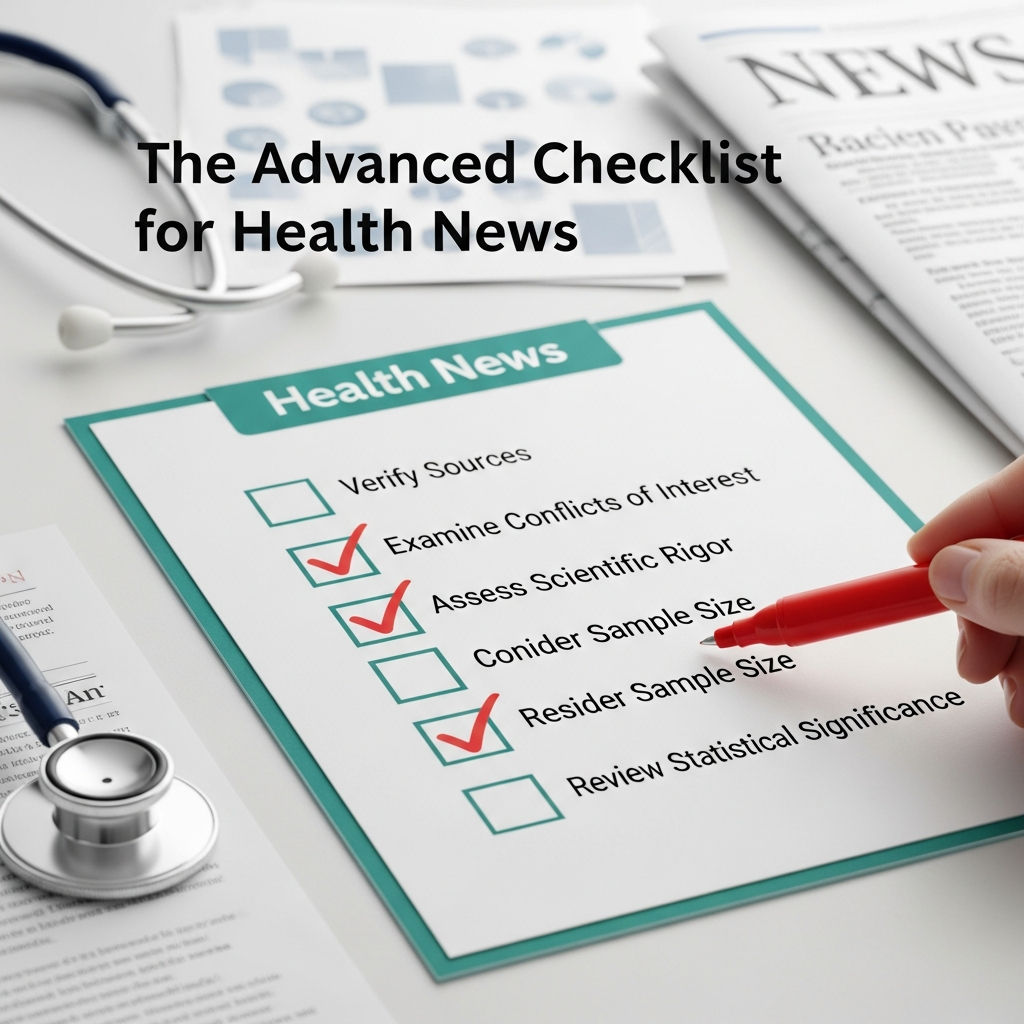
Before you share, write about, or act on health news, run it through this quick-fire summary of our advanced checklist:
- Source: Is it a peer-reviewed study or just a press release?
- Subjects: Was it done in humans, animals, or cells?
- Design: Was it an RCT, or just an observation?
- Magnitude: Is the absolute risk mentioned, or just the scary relative percentage?
- Conflict: Who paid for the study?
- Context: Does this fit with previous science or is it a “lone wolf” study?
Conclusion: The Importance of Healthy Skepticism
In the digital age, being an informed consumer of health news is a form of self-defense. By using this advanced checklist, you move from being a passive recipient of information to an active evaluator of evidence. Remember: true medical breakthroughs are rare, and science is a slow, methodical process of self-correction. If a health news story sounds too good to be true—or too terrifying to ignore—it is exactly the time to apply the checklist and look closer.